Posts

Showing posts with the label OSI Reference Model

Session Layer in OSI Reference Model| Layer 5 | Session Layer in Computer Network | Tutorial
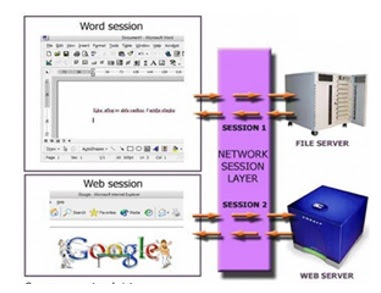
Image
Session Layer: Ø   Session layer in OSI reference model is responsible for establishing, maintaining and terminating the sessions . Ø    Session Layer   is also called as Layer 5 of OSI layer. Ø   It deals with sessions or interactions between the applications(Live example of Phone call) Ø   Session ID is used to identify a session or interaction. Ø   Ex: RPC,SQL,NFS Specific Responsibilities of Session Layer in Computer Network: Ø   Dialog control: The session layer allows two systems to enter into a dialog . It allows the communication between two processes to take place in either half-duplex (one way at a time) or full-duplex (two ways at a time) mode. Ø   Synchronization: The session layer allows a process to add checkpoints, or synchronization points , to a stream of data. For example, if a system is sending a file of 2000 pages, it is advisable to insert checkpoints after every 100 pages to ensure th...

Comparison of OSI Reference Model and TCP/IP Reference Model

Image
TCP/IP vs OSI : OSI(Open System Interconnection) TCP/IP (Transmission Control Protocol / Internet Protocol) Theoretical model Model around which internet is build Has 7 architecture layers Has 4   architecture layers Protocol in-dependent standard Protocol dependent standard Developed by ISO (International Standard Organization) Developed by Department of Defense   (DoD) OSI model has a separate Application Layer, Presentation layer and Session layer. TCP/IP has only application layer which initiates the process, defines the format and create, maintain and terminate the session. Network Layer is both Connection Oriented and Connection less. Network Layer is Connection less. Transport Layer is Connection Oriented Transport Layer is both Connection Oriented and Connection less.          Diagrammatic Comparison between OSI...

Explain TCP/ IP Reference Model in detail

Image
TCP/IP Protocol Suite: Ø   Model around which internet is developed. Ø   Has four architecture layers Ø   Protocol-dependant standard Ø   Theoretical we learn OSI but when it comes to practical implementation , we use TCP/IP protocol suite. Ø     TCP/IP is a hierarchical protocol . The term hierarchical means that each upper-level protocol is supported by one or more lower-level protocols. Physical and Data Link Layers Ø   At the physical and data link layers, TCP/IP does not define any specific protocol. A network in a TCP/IP internetwork can be a local-area network or a wide-area network . Network Layer Ø   At the network layer ,TCP/IP supports IP which uses four supporting protocols: ARP, RARP, ICMP, and IGMP. Internetworking Protocol (IP) Ø   IP is an unreliable and connectionless protocol which does not   provide error checking or tracking. IP transports data in packets called datagrams A...

What is Physical Layer ? | Layer -1

Image
Ø   Physical layer deals with physical transmission of binary data on a given media (Copper, Fiber, Wireless….etc) Ø   Devices work at physical layer are Hub, Modems, Repeaters and transmission media The physical layer is also concerned with the following: 1. Physical characteristics of interfaces and medium: •      The physical layer defines the characteristics of the interface between the devices and the transmission medium. •      It also defines the type of transmission medium 2. Representation   of   bits: •      The physical    layer data    consists    of a    stream   of bits (sequence   of Os   or   1s)   with no   interpretation.   •      To   be   transmitted,   bits   must be encoded into signals electrical or optical . The physical layer defines t...

Search related post on google